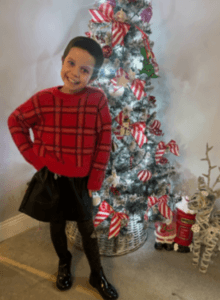
 Abbie was eight years old when she was diagnosed in January 2025 with Neuroblastoma.
She had noticed a lump in her tummy just above her kidney one morning, but said it didn’t hurt. A little concerned, her mum Linzi booked a doctor’s appointment. The GP suggested that it might be an extra rib, but Linzi wasn’t convinced. She took Abbie back for another appointment and this time, the GP referred her for an X-ray at Durham Hospital, but only for peace of mind. The X-ray revealed nothing because, mistakenly, it had only examined her chest, not stomach.
When Abbie later complained of a stitch-like pain down her side, Linzi drove her straight to A&E. Abbie underwent an ultrasound and some blood tests. The results suggested an issue and Abbie was transferred immediately to the Royal Victoria Hospital in Newcastle. It was here that further tests revealed a two-litre tumour, a sizeable mass. The likely diagnosis was either Wilms tumour (Nephroblastoma) or Neuroblastoma. A biopsy was taken and two days later, the latter was confirmed.
The family barely had time to catch their breath.
Abbie undergoing an intensive 80-days of chemo
Abbie had a central line fitted and an intensive 80-day course of chemo began. No sooner had this finished and Abbie underwent a stem cell harvest to ensure she had cells to improve her immune system after the more high-dose chemo that was to come. She also had her ovary removed, as the next stage of treatment would leave her infertile. It was a lot for a child of eight to take in. Abbie was mostly concerned about the surgery as she hates needles, so she needed to understand the necessity of the procedure. Dr Gail, her consultant, explained it in a way Abbie could understand: “We’re going to look after your ovary until you need it, so the nasty medicine can’t hurt it”.
The high-dose chemo was one of the toughest times for Abbie.
She spent five weeks in isolation, which was a very lonely and difficult time for her. After this, Abbie’s stem cells were put back, helping to give her immune system a much-needed boost. She also needed multiple blood and platelet transfusions.
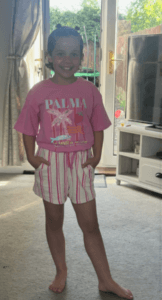
Abbie cut her hair in a bob during chemo
It was during the high-dose chemo that Abbie’s hair began to fall out. She’d always had lots of it – before treatment, it had grown right down her back – and felt distraught of the thought of losing it. As far as she was concerned, long hair was part of her identity, and she was certain that her friends would no longer like her when it was gone. Linzi tried to soften the moment by cutting her own hair and Abbie’s cut into a bob. It helped for a while, but eventually Abbie’s hair began to fall out more significantly. Abbie clung on to it, cherishing even the wispy bits, before accepting that it was all going. At this point, she refused to wear a wig and found a way to make sense of her new look, telling her friends that ‘the magic medicine’ had taken it away for now, but it would be back. ”Her friends were great,” says Linzi. “They didn’t bat an eyelid when they first saw her without hair”.
When Abbie had sufficiently recovered from the high-dose chemo, she began four weeks of proton beam therapy at the Christie Hospital, Manchester, where the family moved temporarily.
Proton beam therapy was judged to be safer than radiotherapy, which posed risks to all the organs and key areas near the site of the tumour, which included her liver, kidneys, the base of her lungs, her spine and abdomen.
“Abbie remained remarkably cheerful throughout this part of her journey,” says Linzi.
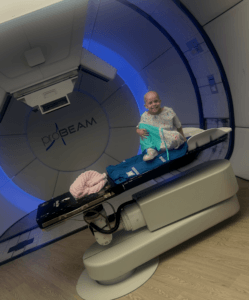
Abbie undergoing proton beam treatment
The treatment was not over yet. After proton beam therapy, Abbie began five months of immunotherapy treatment. This took the form of a line and medicine contained in a small backpack, which Abbie carried for ten-day stints, including in bed. At first it caused a great deal of discomfort and Abbie was admitted to hospital to have morphine. But after a while, the pain eased and Abbie could tolerate it without medication.
In March 2026, the family was told that Abbie was in remission. She is now on maintenance medication, which will last for the next two years.
“As you can imagine,’ says Linzi, ‘our whole life was turned upside down. There was so much to take in and process, and we were unable to work for most of the treatment period. Abbie still has her bloods checked once a month and has scans every three months, so it remains a very anxious time. We try to take things one day at a time, grateful for where we are now, compared to where we were.”
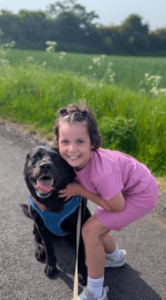
Abbie with her dog Rocky
Throughout her treatment journey, Abbie refused to say she was poorly. She has gone into school when she could and amazed everyone with how she has adapted, even to the trauma of losing her hair. This little girl’s positivity has been infectious. “She is so funny, friendly and caring” says her mum. “She has made so many new friends in staff and other children on the wards.”
Abbie loves dancing, swimming, football and being active in general. “She enjoys spending time with her friends and family, and adores her dog, Rocky.”
The teddy’s unexpected arrival took her mind off what was happening
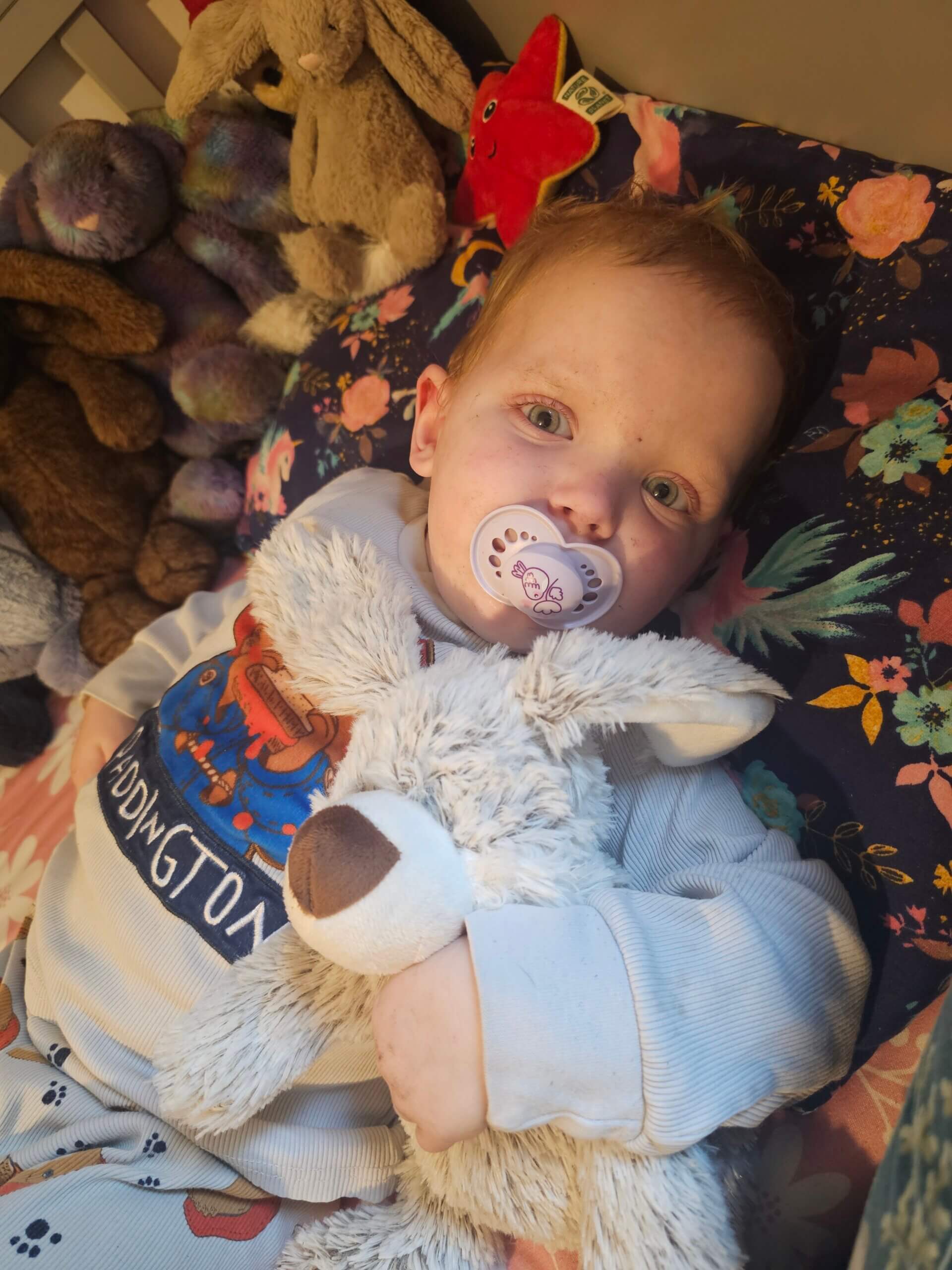
The Christmas Warmies teddy arrived in the depths of her treatment, a difficult time for all the family. Abbie was at her lowest, in discomfort and struggling to sleep. “Abbie was having tummy pain from the chemo,” says Linzi. “The nurses would warm it up and put it on her tummy, and then she was able to fall asleep. It brought her a lot of comfort. More than that, the teddy’s unexpected arrival took her mind off what was happening, which was so important.”
Linzi is so grateful to the donors who made the gift of a soft warmie possible. “It’s lovely that there are people who think of children like Abbie undergoing cancer treatment. They brought comfort to us all.”
Cuddles for Christmas
Sadly, many children with cancer may spend the time leading up to Christmas in a hospital, undergoing cancer treatments instead of enjoying all the festive fun. During these times, a warmable teddy can make a difference.
This Christmas, our aim is to send 1,200 bears to hospitals across the UK by 21st December to ensure that children like Abbie, feel comforted and less alone.
Will you help us send a warmable bear to a child this Christmas?